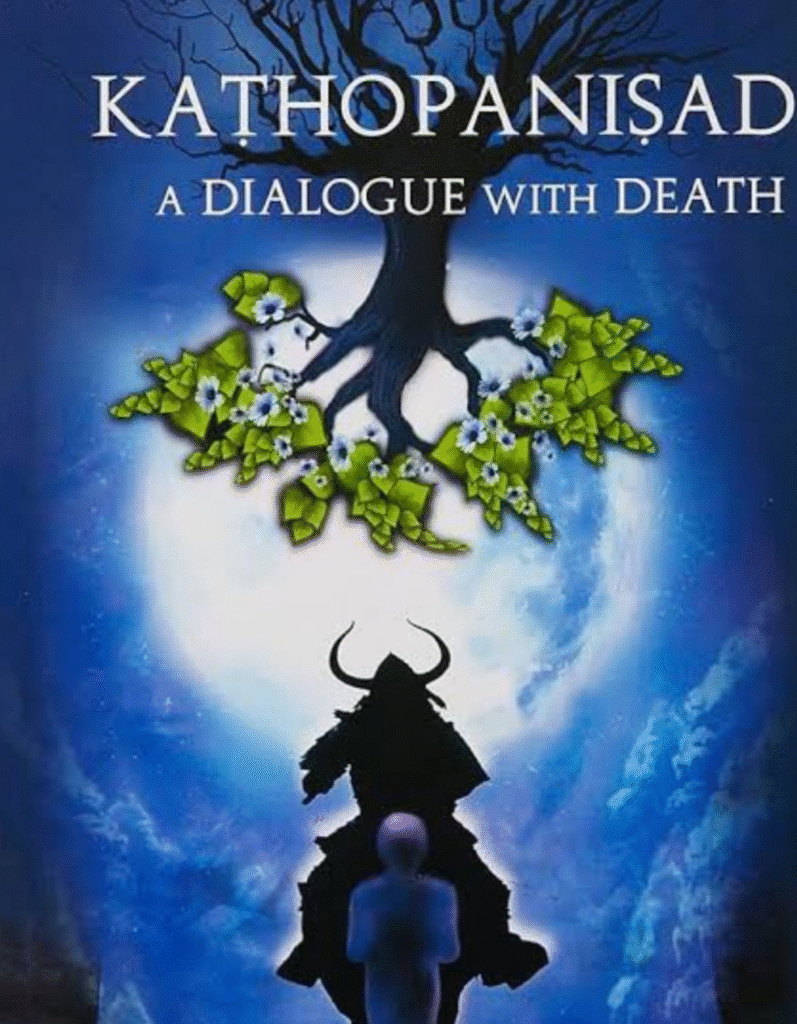
The story of Yama and Nachiketa is the conversation between a young boy, Nachiketa and the Lord of Death – Yama. Nachiketa was the son of a sage named Vajashravas who was performing a yagna in which he had to give all his possessions as a mark of detachment. All the old and sick cattle were given away by Vajashravas. Nachiketa, who was minutely observing this, thought that his father who was deeply attached to him, should also give him away as part of the yagna. When Nachiketa inquired his father to whom he would be given, his father irritatingly replied that he would give him to the Lord of Death, Yama. Immediately, he realized his mistake and his heart was full of remorse. But when he looked at Nachiketa, he was calm and composed. He began his journey towards the realm of death and finally reached Yama’s abode. As Yama was not there, Nachiketa waited outside the door for three days without food and water. When Yama arrived and came to know that a young boy of twelve years had waited for him for such a long duration, he apologized to him and offered him three boons.
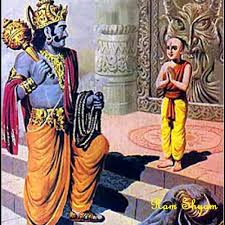
The first boon was that his father should not be angry with him when he returned back home. He should accept him with unconditional love. This boon was immediately granted. His second boon was to learn the sacred fire sacrifice. Yamraj explained to him the deep meaning of fire (divine energy), which is present in each and every individual. One who kindles this inner fire and embraces it with utmost devotion attains the highest state of bliss. Nachiketa listened intently and absorbed this knowledge completely.But Nachiketa’s curiosity was still not satisfied. He wanted to delve deep down into the Ocean of Truth. For his third boon, Nachiketa wanted to know the mystery of Death. He asked Yamraj — “O Lord of Death, is death the absolute end or is there a greater truth beyond that?” Nachiketa had asked such a profound question that Yamraj was perplexed. He tried to dissuade Nachiketa and offered him all the worldly pleasures. But Nachiketa was unmoved by all these temptations. He insisted Yamaraj to impart him that knowledge that is beyond all limitations. This part of Kathopanishad highlights the fourfold qualifications of a true student — vivek, vairagya, virtues, and intense longing for liberation through knowledge. His objective introspection was so crystal clear that even Yama bowed down before his excellence. All human beings possess these virtues but it is really unfortunate that we limit these qualities at the conscious level and are so immersed in the worldly affairs that even if such things dawn on us, they are only temporary because they are overshadowed by the objects of the world.Yamaraj explained to Nachiketa, “We all have two options in life: Shreyas and Preyas. Shreyas is the path of values, and Preyas is the path of valuable goods (possessions). We cannot divide Shreyas and Preyas into a watertight compartment. They both come together. A prudent person examines them, contemplates, and then chooses his path. We have all the things in life, but we lack right thinking. So we end up in disaster . To know the nature of Self is Shreyas — this nature of the path is very challenging, so few opt it. Yamraj bestowed this knowledge on Nachiketa. What we call Shreyas is Vidya, and Preyas is none other than Avidya. They both are poles apart. People who are engulfed in thick layers of ignorance think themselves to be very wise, become leaders, and they fall in the pit with their followers.
When Nachiketa, at such a young age was determined to seek the highest knowledge, then the question arises: “Why do people don’t seek such knowledge?” Many are not aware of its existence, some who come to know about it have no desire to attain it, some give up halfway because it is tedious, and some don’t have that yearning to achieve this highest state of bliss. Both the teacher and the student should have that fire within which is unwavering in any circumstance and not affected by temptations.
Both should have the skill to traverse the fathomless ocean of knowledge and procure the Ultimate Reality.
Yamraj appreciated the path of righteousness which Nachiketa had taken — he threw light on the fact that the Soul continues its journey even after the body dies because the Soul is immortal. It transcends from one body to another. When one attains self-realisation, one merges back into the Supreme, which is infinite. When the person knows about this Atma Swaroop, his joy and sorrows vanish .Adi Shankaracharya in his Bhashya very beautifully says, “Withdrawing the mind’s attention from the external world and seeing the Self in your heart — this is called meditation. This is Sat Chit Anand.”Yamraj told Nachiketa, “The doors of liberation are already open for you. You have to just enter into it.” The cosmos embraced the energy of Nachiketa’s enlightenment.
This story leaves us with food for thought — we have limited our thoughts and qualities at the physical level but the fact is that the energy of Self is limitless. We have the treasure within yet we are seeking it outside.
REFERENCES Kathopanisad:Shankarabhasya
Talks on Kathopanisad : An immortal dialogue on Peace and Bliss by Swami Tejomayananda

Leave a Reply